The Department of Education Quality Control works closely with faculties, departments, and other structures to improve the quality and efficiency of education at the university.
 CAMU
CAMU
ActaCAMU scientific journal
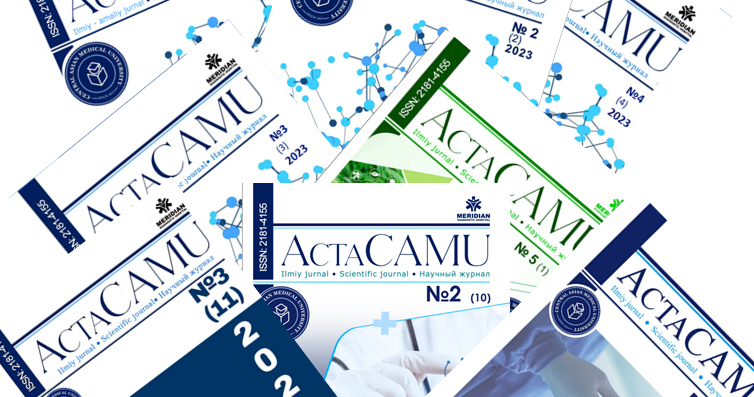
"ActaCAMU" Scientific Journal is the official academic journal of the University, providing a platform for publishing high-quality research results. The journal welcomes contributions from faculty members, researchers, and doctoral students.
The scientific journal was founded in November 2022. The editorial board of the journal includes doctors of sciences and candidates of sciences from republican and foreign medical institutions.
International Standardization Number (ISSN): 2181-4155. Each issue of the journal is constantly uploaded to the camuf.uz website.
The university journal was included in the list of national scientific publications recommended for publishing the main scientific results of dissertations in medical specialties by the resolution of the Higher Attestation Commission No.361/6 of 2024.
ActaCAMU Scientific Journal (ActaCAMU) is a double-blind peer-reviewed journal. Every paper submitted to ActaCAMU Journal for publication is subject to peer review. The peer review in this journal is an evaluation of the submitted paper by two or more individuals of similar competence to the author. It aims to determine the academic paper's suitability for publication. The peer review method is employed to maintain standards of quality and provide credibility of the papers. The peer review at ActaCAMU Journal proceeds in 9 steps which will be carried out for a maximum of 3 months with the following description
1. Submission of Paper
The corresponding or submitting author submits the paper to the journal. This is carried out via an online system supported by the Open Journal System (OJS).
2. Editorial Office Assessment
The submitted paper is first assessed by editor. The editor checks whether it is suitable with the journal focus and scope. The paper's composition and arrangement are evaluated against the journal's Author Guidelines to make sure it includes the required sections and stylizations. In addition, an assessment of the minimum required quality of the paper for publication begins at this step, including one that assesses whether there is a major methodological flaw. Every submitted paper which passes this step will be checked by ANTIPLAG to identify any plagiarism before being reviewed by reviewers.
3. Appraisal by the Editor-in-Chief
The Editor-in-Chief checks whether the paper is suitable for the journal, original enough, interesting, and significant for publication. Otherwise, the paper may be rejected without further review.
4. Invitation to Reviewers
The handling editor sends invitations to individuals who he or she believes would be an appropriate reviewers (also known as referees) based on expertise, the closeness of research interest, and no conflict of interest consideration. The peer review process at the Journal of ActaCAMU involves a community of experts in a narrowly defined field of education and teaching zone who are qualified and able to perform reasonably impartial reviews. The impartiality is also maintained by the double-blind peer review employed in this journal. That said, the reviewer does not know the author's identity, conversely, the author does not know the reviewer's identity. The paper is sent to reviewers anonymously. which amounted to 2 reviewers in accordance with the field in the analysis.
5. Response to Invitations
Potential reviewers consider the invitation against their own expertise, conflicts of interest, and availability. They then decide to accept or decline. In the invitation letter, the editor may ask the potential reviewer for the suggestion of an alternative reviewer, when he or she declines to review.
6. Review is Conducted
The reviewers allocate time to read the paper several times. The first read is used to form an initial impression of the work. If major problems are found at this stage, the reviewers may feel comfortable rejecting the paper without further work. Otherwise, they will read the paper several more times, taking notes so as to build a detailed point-by-point review. The review is then submitted to the journal, with a recommendation to accept, or reject it, or else with a request for revision (usually flagged as either major or minor) before it is reconsidered.
7. Journal Evaluates the Reviews
The Editor-in-Chief and handling editor consider all the returned reviews before making an overall decision. If the reviews differ widely between both reviewers, the handling editor may invite an additional reviewer so as to obtain an extra opinion before making a decision.
8. The Decision is Communicated
The editor sends a decision email to the author including any relevant reviewer comments. Reviewer comments is sent anonymously to the corresponding author to take the necessary actions and responses. At this point, reviewers are also be sent an email or letter letting them know the outcome of their review.
9. Final Steps
If accepted, the paper is sent to copy-editing. If the article is rejected or sent back to the author for either major or minor revision, the handling editor will include constructive comments from the reviewers to help the author improve the article. The author should make corrections and revise the paper per the reviewers' comments and instructions.
After revision has been made, the author should resubmit the revised paper to the editor.
If the paper was sent back for revision, the reviewers should expect to receive the revised version, unless they have opted out of further participation. However, where only minor changes were requested this follow-up review might be done by the handling editor. If the editor assesses that the article is appropriate and very good in accordance with the recommended revision of the paper, then the article is accepted. Accepted papers will be published online and all are freely available as downloadable PDF files.
This scientific journal strictly adheres to the principles of copyright, protection of intellectual property and lawful use of scientific information. All scientific articles, reviews, graphic materials, tables and other content published in the journal are protected in accordance with the Law of the Republic of Uzbekistan "On Copyright and Related Rights" and international copyright norms. The journal considers openness of scientific information, academic honesty and protection of the interests of the author to be one of its main principles.






Position: rector
ORCID:
Telefon: (+998) 91 482-07-70
Mamasadikov Nurillo Shukrullaevich is an experienced healthcare leader and administrator. He earned a Master’s degree in Forensic Medicine from the Tashkent Medical Academy in 2010 and began his pro...
Position: vice-rector
ORCID:
Telefon: (+998) 99 693-04-60
Botirov Murodjon was born in 1976 in the city of Kuvasay, Fergana region. In 1993, he enrolled in the Medical Center of Fergana State University, majoring in Medical Engineering, and graduated in 1998...
Position: vice-rector
ORCID: 0000-0001-6057-555X
Telefon: (+998)
Normatova Shakhnoza Anvarovna was born in 1976 in the Fergana region. She has a total of 26 years of professional experience. In June 1999, she graduated with honors from the Fergana Branch of the 2nd...
Position: Dean
ORCID:
Telefon:
Mamarizaev Khayrullo graduated from the Fergana Branch of the 2nd Tashkent State Medical Institute in June 2004. He has 21 years of professional experience.
From 2004 to 2006, he served as Head o...